
Manhattan. People lined up for bread and for work, and in the midst of that a general sense that life has been suspended while everyone waits: this is the setting of Boulay’s first story of a marriage: “Mrs. Price.” It is mid-1930s, New York, where the Great Depression bride admires the MetLife Tower and its ongoing construction as a symbol of hope. She sees “there in the sky, a goal, a raising up, a passage of time, tomorrow,” while at her side sits her unemployed guitarist husband, a man whose pride, like many other men’s, has had to pack a lunch.
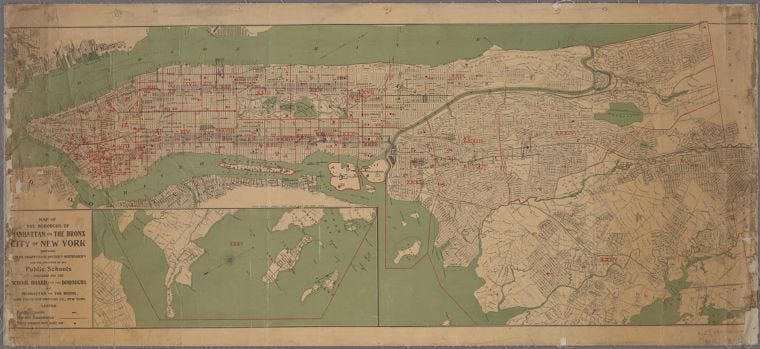
Lionel Pincus and Princess Firyal Map Division, The New York Public Library. "Map of the borough of Manhattan and the Bronx, City of New York: showing school inspection district boundaries and the location of all public schools" The New York Public Library Digital Collections. 1898. https://digitalcollections.nypl.org/items/1f782390-32c9-013b-923a-0242ac110003
Another bride in “Her Big Day” confronts the emptiness of her life amid her neighborhood prospects and pill bottles. Desperation isn’t exactly the right description for Boulay’s women, unless it is a desperate longing to be whole, to have meaning in life and work, meaning apart from relationships with men or “my reverend husband’s lord.” Agency. Autonomy. And it is the third story that carries the most weight and beauty for me in the early part of the collection.
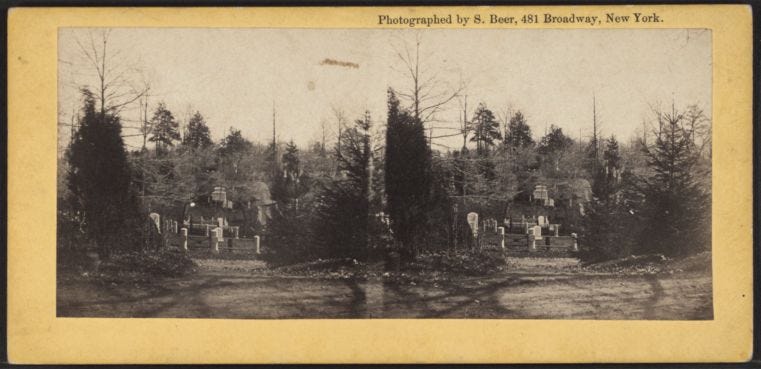
We travel back to 1868 in “Principal of No. 4,” to the Manhattan’s Colored School No. 4, in which the “rows of windows let in the light of the city,” and a special opportunity exists for Imogen Howard in teaching music: a talented young violinist, Walter Craig, to guide, Principal Sarah Tompkins to work for and with — Sarah, who walks the streets of New York seeking truant students, who supports the temperance movement and the right for black people to vote, who advocates for night school attendance in the community because where there is education, there is potential. Sarah, who longs for a closer relationship with her own daughter. Sarah, who grieves her husband as his body lies in the Green-Wood Cemetery, a place that serves as a thread with other stories.
I often tell my students, “We bring our own experiences to what we read, and they have an effect on our interpretation and connection.” As a teacher who has given her life to education, and mother to a grown daughter, I commiserate with Principal Sarah. As a music lover, I seek the kind of resolution that arrives in Mendelssohn’s Opus 61, a piece ahead of its time and written near the end of the composer’s life. As a progressive and a lover of literature, I thrill at the surprise visit in this story, one that lifts up everyone. Still, as a white woman reader, I am keenly aware of my limitations in fully appreciating the strength of Sarah’s choices.
Choices are at the heart of this collection: women’s dramatic or practical choices, against a background in which few choices existed. A woman who lived an untenable life with an abusive husband in the late nineteenth century, as in the next story, “The Great White Hurricane",” can choose only between survival and motherhood. Along with the New York settings across this collection, historical figures and events such as the hurricane are aligned and relevant, underscoring the vulnerability of all life, but particularly the lives of women.
Other characters’ choices are also critical, as women in these stories are sometimes in a unique position to help their more vulnerable friends, and may take some risk in doing so. Women’s relationships with their friends are explored along with cycles of life including death. Plots at Green-Wood Cemetery become a subject among the women at a senior living community in “Shore Road,” set in 2020 during the Covid epidemic. Most members of this group are conscious of the potential for death and the importance of planning where (and with whom) they would like to be buried, and when the illness hits home, they must confront the inevitability of loss. But this experience doesn’t encapsulate the fullness of their individual lives, rich with intimacy.
I did find it hard to transition to “Collisions,” in which a 1960’s wife finds herself in what might appear a too-familiar role of the disappointed wife of a scoundrel. You might have heard me sigh when she follows him around. I am relieved to tell you that Martha has an interior life and an imagination that comes awake amid the reality of her marriage, and the story as a whole is satisfying.
I caught my breath when I turned to “As Far as the River,” because I saw the date: 2001, and the central character, Maria, looking out the window on the 101st floor of a firm. But then she’s in the park with her beloved and Leonard Bernstein. There’s a party with children and Puerto Rican flags. “How to explain classy to a 5-year old?” Still, there’s talk of the cemetery, and I grow uneasy.
The next story, “Love and Infamy” struck me as one of the most troubling, its pre-Civil war environment reminiscent of the tension in America today. Another shining woman, waiting on a man, believing in him, setting him up for success by undermining her own values. How do you think it ends for Maggie, with her vulnerable words carrying over to “The Side Gate,” where we wait for the fortune-teller to tell us what the cards say in the city of “Yes, we can,” while someone sings at the foot of a grave.
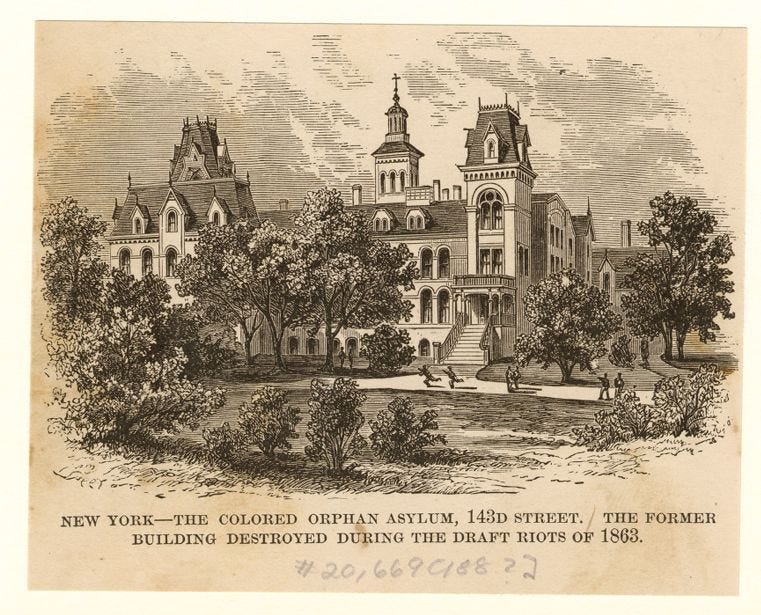
The Miriam and Ira D. Wallach Division of Art, Prints and Photographs: Picture Collection, The New York Public Library. "New York, the Colored Orphan Asylum, 143d Street" The New York Public Library Digital Collections. 1880 - 1889. https://digitalcollections.nypl.org/items/984fd5f0-c55d-012f-de26-58d385a7bc34
Boulay listens to the voices of the past and present, and invites us to listen with her. When the stories begin to come full circle in “The Lots” (2017) and even the voices of the dead are able to communicate from their unmarked spaces in Greenwood, I understand the whole work’s devotion to recognizing souls that were sacrificed to the injustices of the times in which they lived. The black children at the Colored Orphanage Asylum once laughed and dreamed of a future. The monk parakeets at the cemetery carry their voices now.
One more note: the map of Greenwood at the end completes the gift of this novel in stories. I have lingered over it, traced its lines and curves, and blessed the sylvan water. Come walk with me, in gratitude to this author and her characters.
Visit Boulay’s website and get the book.
Thank you,
Tamara Miles
WNBA Blog Chair
p.s. Send me your reviews, thoughts on reviews, and so on via message here. Thank you!
Tamara ~ I am so touched by this review! Beautiful writing. Thank you for your generous words. 🦜